


Home Workout Plan for Beginners: Everything You Need to Get Started
- Mav

- Jun 7
- 9 min read
This post contains affiliate links. If you purchase through my links, I may earn a small commission at no extra cost to you. I only recommend products I genuinely believe in.
Reading time: ~10 minutes
Does Working Out at Home Actually Work?
You've probably heard this before. Someone tells you that you need a gym membership, or a personal trainer, or at least a set of dumbbells, before real progress is possible. It sounds reasonable. It also isn't true.
The evidence is clear. A 24-week study on novice lifters found that resistance band training produced strength gains in squat and bench press equivalent to traditional free weights. No significant difference between groups. Beginners using bands got just as strong as beginners using a gym. What matters is consistency and progressive overload — not the postcode of your workout.
If you're starting from scratch, a pair of resistance bands and a clear plan will get you further than an expensive gym membership you dread using. This resistance bands set covers all five resistance levels you'll need from week one through to month six, at a fraction of what a month's membership costs.
Your 4-Week Beginner Home Workout Plan
This plan is built around the fundamentals that actually produce results: compound movements, progressive overload, and enough rest for your muscles to rebuild stronger. Three sessions per week. No more than 40 minutes each.
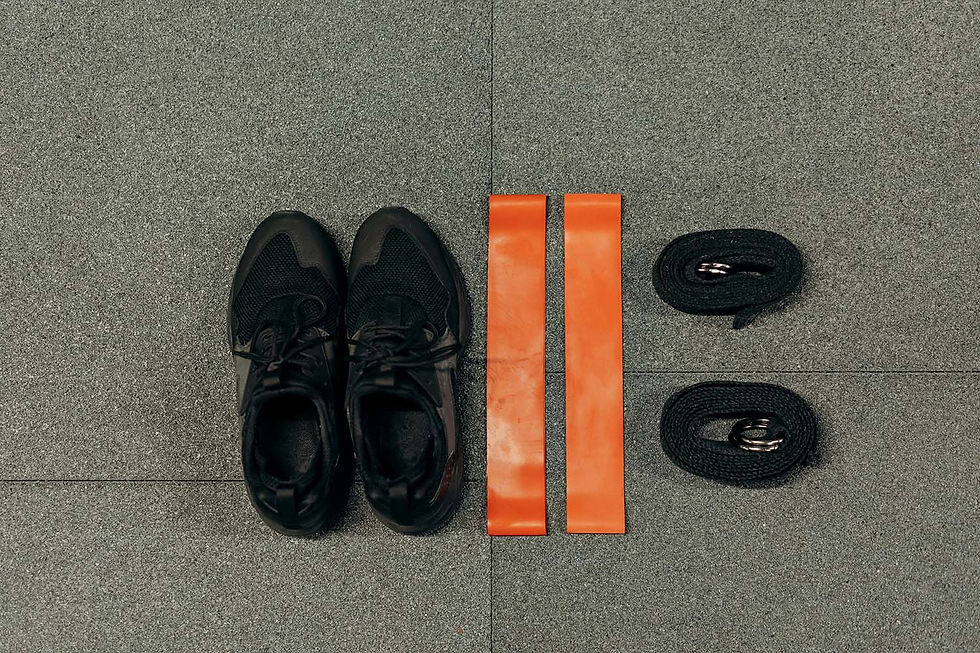
What You'll Need
A resistance bands set (five levels)
An exercise mat
A small amount of floor space
Water
That's it. No machine. No mirrors. No audience.
How the Plan Works
You'll train three days per week with a rest day between each session — something like Monday, Wednesday, Friday, or Tuesday, Thursday, Saturday. The spacing matters. Muscles grow during recovery, not during the workout itself.
Sessions alternate between upper-body focus (Sessions 1 and 3) and lower-body focus (Session 2). Every exercise has a set and rep target. When those reps start to feel genuinely easy — not just manageable, genuinely easy — you increase the resistance or add two reps. That's progressive overload. That's how results happen.
Week 1–2 Workouts
Session 1 and 3 — Upper Body and Core
Rest 60–90 seconds between sets. Aim for controlled reps — slow down and count to three on the way back.
Push-ups — 3 sets of 8 reps
Start on your knees if needed. Hands slightly wider than shoulder-width. Lower your chest toward the floor, pause, push back up. Full range beats fast reps every time.
Resistance band rows — 3 sets of 10 reps
Anchor the band under both feet. Hinge slightly forward at the hips, pull both ends of the band toward your lower ribs. Squeeze your shoulder blades together at the top.
Resistance band bicep curls — 3 sets of 12 reps
Stand on the band, palms facing forward. Curl both hands toward your shoulders. Lower slowly.
Plank hold — 3 sets of 20 seconds
Forearms on the mat, body in a straight line from heels to head. Breathe normally. Don't let your hips sag.
Dead bug — 3 sets of 8 reps per side
Lie on your back, arms pointing to the ceiling, knees bent at 90 degrees. Lower your right arm and left leg toward the floor simultaneously — keep your lower back pressed into the mat. Return and switch sides.
Session 2 — Lower Body and Core
Bodyweight squats — 3 sets of 12 reps
Feet shoulder-width apart, toes turned out slightly. Send your hips back and down, keeping your chest lifted. Stand back up through your heels.
Reverse lunges — 3 sets of 8 reps per leg
Stand tall, step one foot behind you, lower your back knee toward the floor. Push through the front heel to return to standing. Alternate legs.
Glute bridges — 3 sets of 15 reps
Lie on your back, knees bent, feet flat. Drive your hips toward the ceiling, squeeze at the top for a second, lower slowly. Add a light resistance band above your knees for extra challenge.
Lateral band walks — 3 sets of 12 steps each direction
Place a light resistance band just above your knees. Stand in a slight squat position. Step sideways, maintaining tension on the band throughout. Keep your hips level.
Hip hinge with band — 3 sets of 10 reps
Stand on the band, hold both ends. Hinge at the hips — back flat, soft bend in the knees — feel the stretch in your hamstrings. Drive your hips forward to stand. This teaches the movement pattern behind every deadlift you'll ever do.
Week 3–4 Progression
Two things change in weeks three and four.
First, add two reps to every exercise. Push-ups go from 8 to 10. Squats go from 12 to 14. Glute bridges go from 15 to 17.
Second, assess your resistance. If the final reps of a set feel genuinely easy — not challenging, just mechanical — move to the next band level. Keep the form crisp before adding load.
Soreness in weeks one and two is normal. Your muscles are adapting. By week three that soreness typically settles, which is when most beginners mistakenly think the training has stopped working. It hasn't. That reduction in soreness means your body has adapted and is ready to be pushed further. That's when the progression matters most.
How Fast Will You See Results?
This is the question everyone has but rarely asks aloud. Here's what the research actually shows for beginners following a structured home training plan.
Weeks 1–2: Neural adaptation. Your nervous system is learning the movement patterns. Strength improves before any visible muscle change — beginners often feel stronger within two weeks even when nothing looks different. This is real progress.
Weeks 3–4: A study on beginner trainees recorded an 18% improvement in squat strength at the four-week mark. You'll also begin to notice your posture improving, your energy levels shifting, and the exercises feeling more controlled.
Weeks 5–8: Continued strength gains of 14% from the fourth to the sixth week in the same research. An 8-week home-based resistance training programme showed a 24% increase in power output in the fast-speed group. Body composition changes — reduced body fat, increased muscle tone — become more visible in this window.
What this means in practice: You won't wake up transformed after two weeks. But if you show up three times a week and push the reps honestly, weeks five and six feel noticeably different from week one. That's not hype — it's what the data consistently shows for beginner trainees.
One practical note: exercise is one of the most effective natural ways to lower cortisol naturally. If stress and fatigue have been obstacles to consistency, building a regular movement habit directly addresses the hormonal root cause.
If you want to have the equipment ready before week one begins, the resistance bands set arrives with Prime. Five resistance levels, one set, the whole programme covered.
The Equipment Worth Having
These three products cover the full plan above. None of them are expensive. None of them take up meaningful space. Together they're everything you need to train consistently for the first six months.
1. Gritin Resistance Bands Set — The Versatile Foundation
Editorial rating: 4.6 / 5
This is the product that genuinely replaces a gym for a beginner. Five resistance levels in a single set means you can start on the lightest band in week one and still be using the same set six months later when you've progressed. The skin-friendly material avoids the discomfort that makes cheaper latex bands impossible to use for leg work.
The carrying case keeps them together, which matters more than it sounds when you're trying to build a consistent habit. No hunting through a drawer before every session.
They work for every exercise in this plan — rows, bicep curls, glute bridges, lateral walks, hip hinges. One product, the whole programme.
2. KAYMAN Exercise Mat — Non-Slip, Right Size
Editorial rating: 4.5 / 5
The floor is a terrible place to train without a mat. Cold, hard, and slippery at the worst moments. This mat is 183 x 60 cm — enough room for push-ups, dead bugs, glute bridges, and planks without running off the edge mid-rep.
The non-slip surface stays put on both hardwood and carpet. It's thick enough to cushion knee push-ups and wrist pressure without being so thick it creates balance problems during standing work. Carrying straps mean it rolls up and stores against a wall without taking up drawer space.
A mat this size at this price point is the single most impactful pound you'll spend on home training.
3. Fitness Journal (A5 Hardcover) — The Progress Tool That Most Beginners Skip
Editorial rating: 4.4 / 5
Progressive overload requires tracking. If you don't write down what you did last session, you have no reliable way to know when to increase the resistance or reps. Most beginners skip this and then wonder why they've stopped improving after six weeks.
This A5 hardcover journal has a clean layout designed for workout logging — sets, reps, and weight (or resistance level) per exercise. It takes two minutes to fill in after each session. That two minutes is the difference between training with a plan and just going through motions.
A fitness journal also builds the habit loop that makes showing up feel automatic rather than effortful.
Also worth knowing: If you're thinking about supporting muscle recovery from outside the workout, best supplements for women over 30 covers the evidence on magnesium, protein, and omega-3 for women beginning a training programme.
Beginner Mistakes That Stall Results
Training every day without rest days. More sessions do not equal faster results for a beginner. Muscles rebuild during the 48 hours after training, not during the session itself. Skipping rest days means your muscles never finish adapting before you break them down again. Two or three days of training per week, done consistently, will outperform six days done with fatigue.
Doing the same workout forever. The first time you do bodyweight squats, your body has to work hard to do them. The twentieth time, it doesn't — unless you've made them harder. Progressive overload (adding reps, or moving to a heavier band) is what forces your body to keep adapting. Without it, you maintain fitness but don't build it.
Starting with too much, too fast. Three sets per exercise, three sessions per week sounds modest. For a body that has been largely sedentary, it is not modest at all. Beginners who do five sessions in week one and two sessions in week two because of soreness get worse results than beginners who do exactly three sessions every single week. Consistency beats intensity at this stage.
Ignoring the lower body. Legs make up roughly half the muscle mass in the human body. Programmes that focus on push-ups and arm work while neglecting squats and hinges are leaving half the results on the floor. The lower body sessions in this plan are not optional extras.
Frequently Asked Questions
Do I need any equipment to do a beginner home workout?
You can start with pure bodyweight — push-ups, squats, lunges, planks. A resistance bands set adds enough variety and load to train every major muscle group, and it's the most cost-effective piece of equipment a beginner can own. A mat makes floor work practical and comfortable.
How many days a week should a beginner work out at home?
Three days per week with rest days in between is the evidence-backed starting point. The NHS recommends at least two muscle-strengthening sessions per week for adults. Three gives you slightly faster progress without the recovery problems that come from training every day.
Will I lose weight doing a home workout plan?
Resistance training increases lean muscle mass, which raises resting metabolism over time. Combined with a reasonable approach to eating, a consistent beginner training plan does contribute to fat loss — though the primary adaptation in the first eight weeks is strength and fitness improvement, not dramatic body weight change.
How long should a beginner home workout session be?
The sessions in this plan take 30–40 minutes including warm-up and cool-down. Longer is not better for beginners. Quality of effort and consistency across weeks matter far more than session duration.
Is it normal to feel very sore after the first few workouts?
Yes. Delayed onset muscle soreness (DOMS) — the stiffness that peaks 24–48 hours after training — is a normal response to new movement patterns. It does not mean you've injured yourself, and it does reduce significantly after the first two to three weeks as your muscles adapt.
Can I do this plan if I haven't exercised in years?
This plan is specifically designed for that situation. Start with the lightest resistance band, do knee push-ups rather than full push-ups, and reduce reps if needed. The goal in weeks one and two is to build the habit and move through the full range of motion — not to hit every number perfectly. The numbers come later.
If you're ready to start, grab the resistance bands and map out your three training days for this week before you close this tab. The plan works. The only variable is whether you show up.
Related reading:
How to Lower Cortisol Naturally — how exercise fits into a broader stress-reduction strategy
Best Supplements for Women Over 30 — supporting recovery with the right nutritional foundations
30-Day Home Workout Challenge — coming soon

Comments